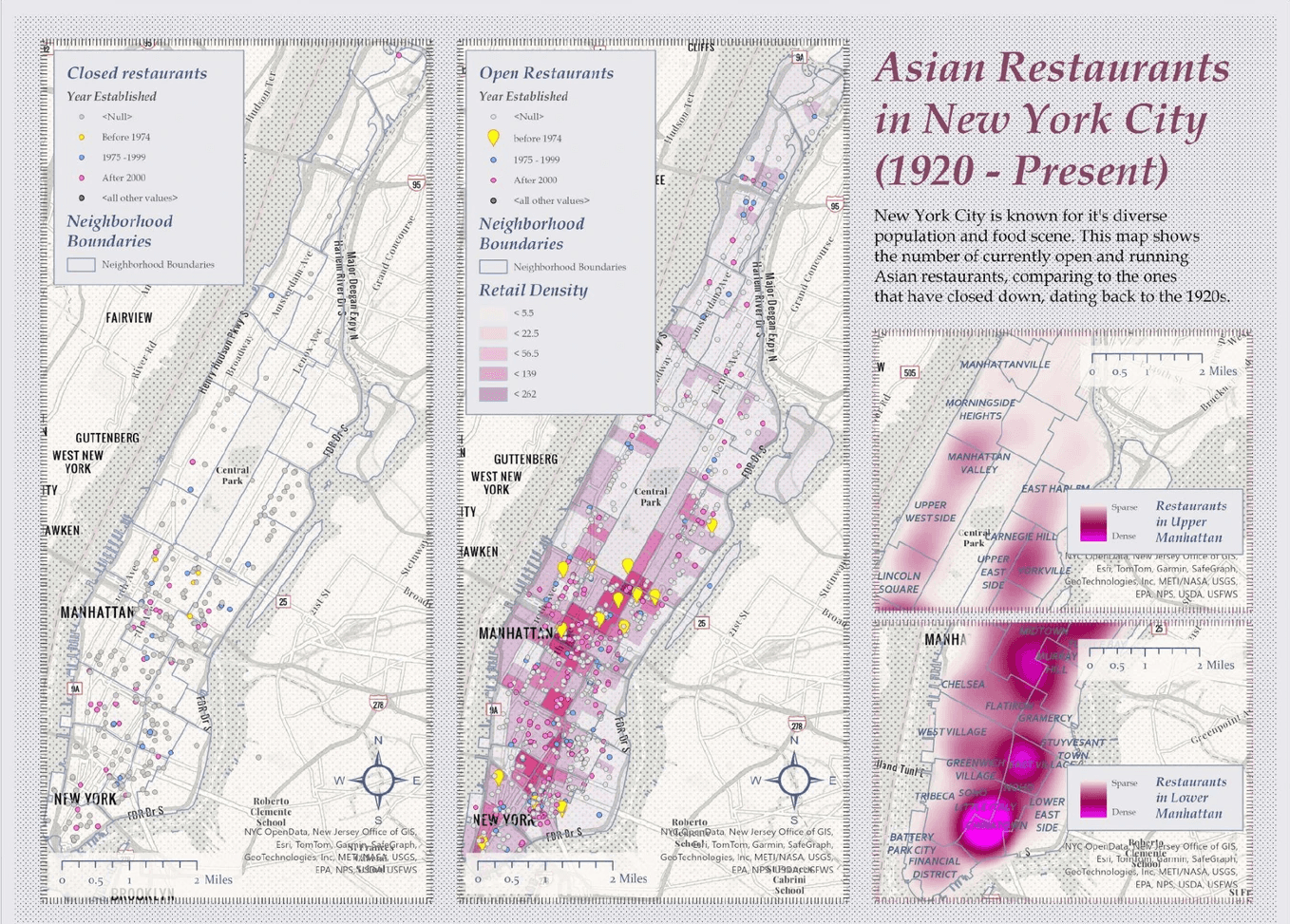
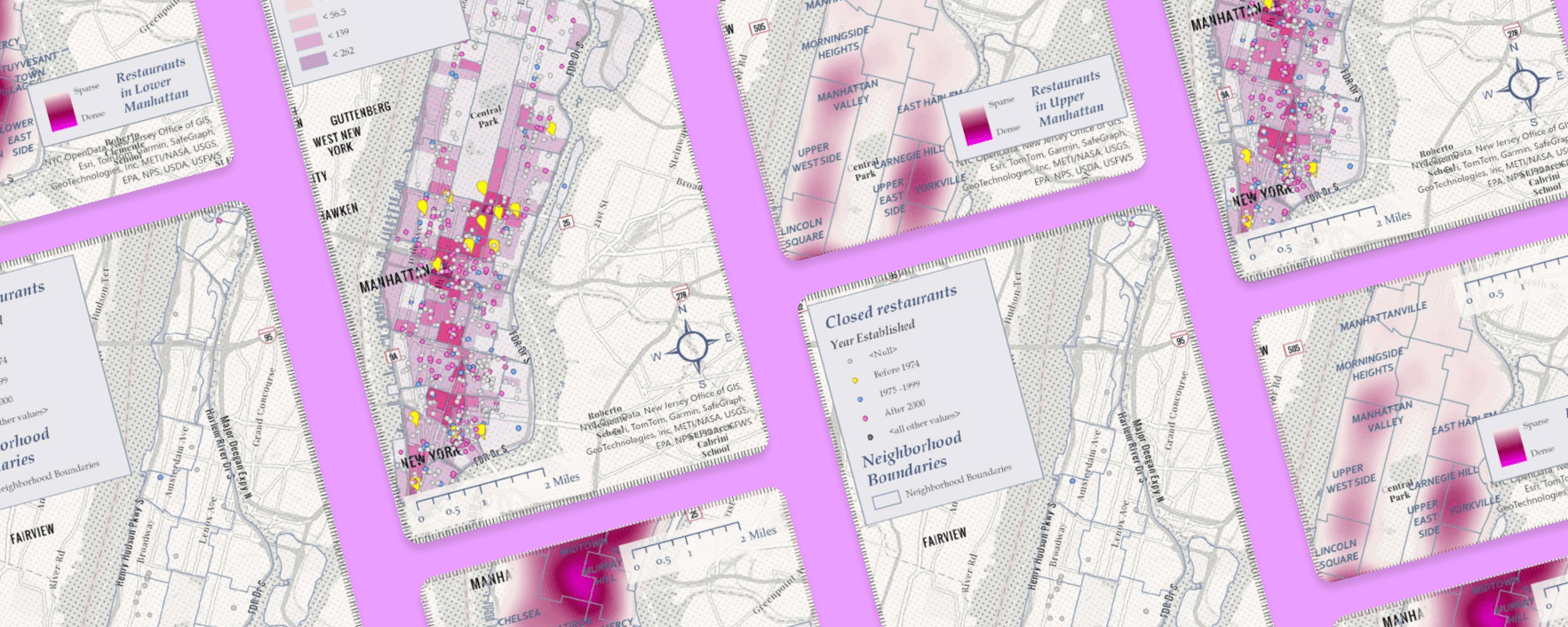
Using archival data and ArcGIS Pro, this project visualizes the evolution of Asian restaurants across NYC, highlighting their growth and distribution.
Approach
Collected historical data on Asian restaurants in NYC from 1920 to 2023.
Analyzed restaurant openings and closures to identify long-term trends.
I used "Reference USA" U.S. Businesses database, with advanced search filters applied to refine the dataset. For this analysis, "New York City" refers to Manhattan. The data was filtered to include both Verified Businesses and Closed/Out of Business restaurants. Within the "restaurants" category, a selection of cuisines—Korean, Chinese, Japanese, Indian, Vietnamese, and Asian Restaurants—was made to broaden the search scope.
To geocode the addresses, I used the “Lion” dataset from NYC Open Data, which provides detailed geographic information for all buildings and addresses in New York City. This dataset served as my locator, enabling precise geocoding of each restaurant’s address. By matching the addresses from the Reference USA dataset with the geographic coordinates in the "Lion" dataset, I was able to accurately pinpoint the location of each restaurant across Manhattan.
An additional dataset used in this analysis was the Location Affordability Index, which provides insights into housing and transportation costs relative to income. This dataset was leveraged to explore Local Retail Density, helping to understand how the concentration of restaurants in different areas correlates with affordability and accessibility.
322 records for “Closed/Out of Business”
918 records for “Verified
Earliest established restaurant was in 1920
Latest established restaurant was in 2023
I began by geocoding the locations using the Lion dataset, which functioned reasonably well as a locator. However, I encountered some confusion when inputting parameters for “Left House Number From” and “Left House Number To.” The dataset lacked clear documentation on column headers, so I selected “FromLeft,” “ToLeft,” “FromRight,” and “ToRight” based on their relevance.
There were some inconsistencies in the formatting of street name abbreviations, such as "Frdrck Dgls Blvd" for Frederick Douglass Boulevard. Additionally, some streets had alternate names, like Malcolm X Boulevard (Lenox Avenue) and Fashion Avenue (6th Avenue), which required extra attention during the geocoding process.
Some interesting patterns emerged among the addresses the program was unable to match. It struggled with recognizing common abbreviations like “E” and “W” for East and West. Additionally, ordinal indicators such as “th” and “nd” in street names caused confusion, leading to mismatches during the geocoding process.
Another interesting insight was that while most records were in Manhattan, a few—around two—were located in Queens and Brooklyn. Upon rematching these addresses, I found that the businesses were indeed in other boroughs, suggesting possible errors in the original address recording.
Google and some light "detective work" revealed the correct addresses.
❌
16 unmatched open restaurants
❌
42 unmatched closed restaurants.
Color Coding and Grouping "Year of Establishment"
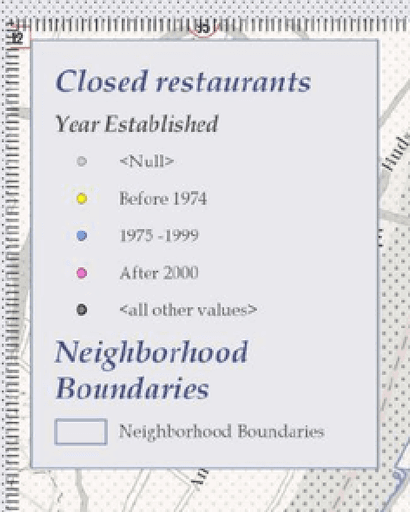
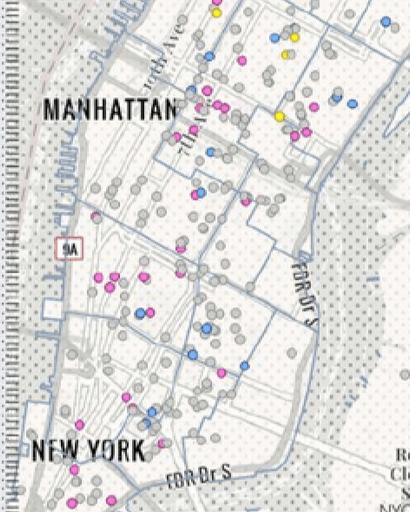
For maps of closed and open restaurants, I color-coded points by establishment year: Before 1974, 1975–1999, After 2000, Null, and Other. I kept null values since the dataset dates back to the 1920s, when many older restaurants lacked records.
2 types of maps
I envisioned this layout to feature two main maps: one showing currently open and running restaurants, and the other displaying those that are closed or out of business.
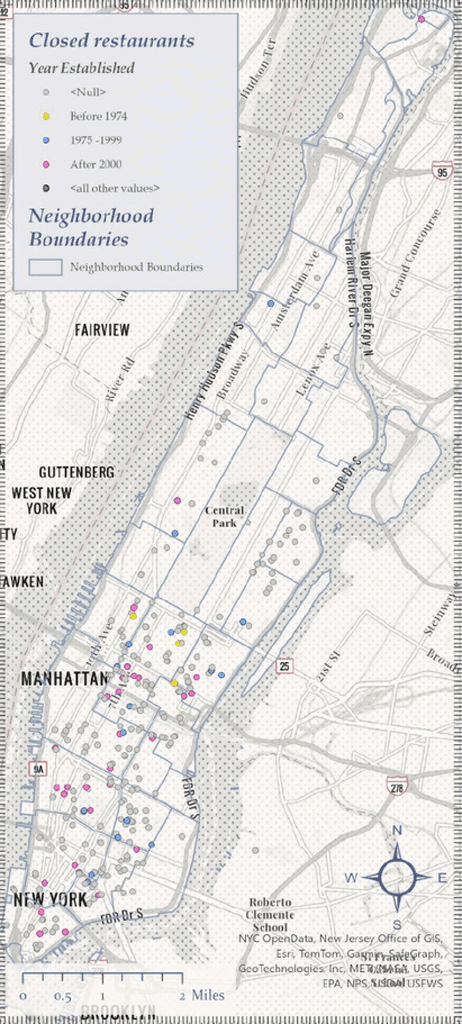
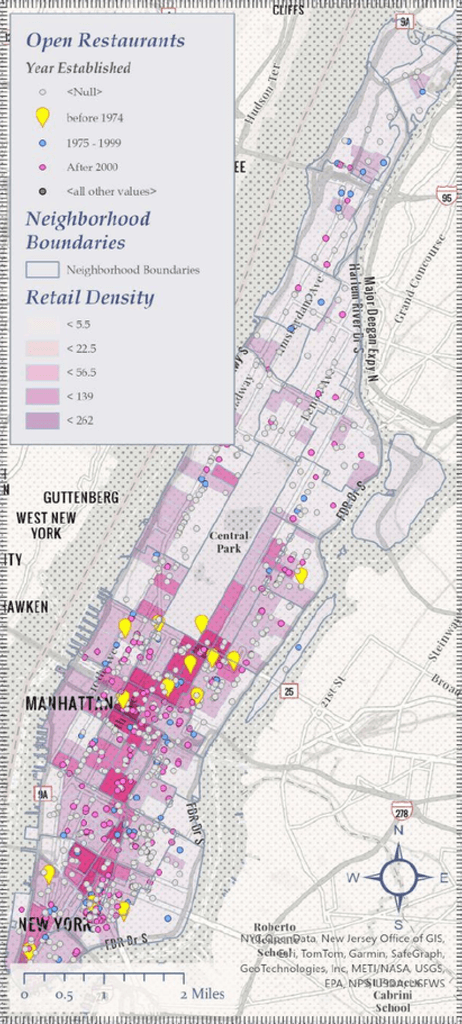
Vintage, Newspaper-Inspired Basemap with a Pop of Color
Working with an archival dataset focused on the growth of Asian restaurants over the years, I envisioned using a vintage, newspaper-inspired basemap to evoke a sense of history. To highlight key data points and add visual interest, I incorporated a pop of color, bringing the map to life while maintaining a nostalgic, timeless feel.